


Celebrating the 20th Annual Dance Parade — May 16, 2026
ABOUT DANCE PARADE NEW YORK
1) ¿Qué es Dance Parade New York?
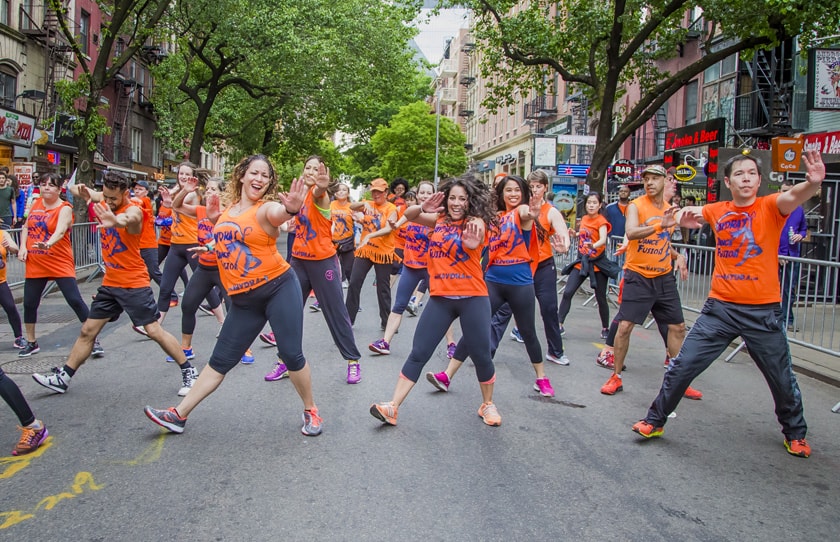
Dance Parade New York is the world’s only parade dedicated exclusively to celebrating the diversity of dance. Each May, more than 10,000 dancers, representing over 100 unique styles, come together to showcase the richness of movement traditions from across the globe.
This full-day celebration includes a vibrant parade through Manhattan followed by DanceFest, a free festival of performances, classes, and social dancing in Tompkins Square Park.
2) ¿Cuándo tiene lugar Dance Parade New York?
The 20th Annual Dance Parade will take place on Saturday, May 16, 2026, rain or shine.
-
Parade Start: 12:00 PM
-
Parade Ends: Approximately 3:00 PM
-
DanceFest: 3:00–7:00 PM in Tompkins Square Park
3) Where is the parade route?
The Parade begins at West 17th Street & Sixth Avenue and travels south on Sixth Avenue before turning east onto 8th Street/St. Mark’s Place.
In Astor Place, each group performs briefly at the Grandstand before continuing to Tompkins Square Park for DanceFest.
Note: Exact route and staging areas are subject to annual adjustments.
4) Which streets will be closed ?
The following streets are typically closed on Parade Day:
-
Sixth Ave (18th–8th Streets)
-
West 17th St (5th–6th Aves)
-
West 18th St (5th–7th Aves)
-
8th St/St. Mark’s Place (6th Ave–Avenue A)
-
Avenue A (7th–12th Streets)
-
Avenue B (7th–10th Streets)
6) What is DanceFest?
DanceFest is the free, post-parade festival held from 3–7 PM in Tompkins Square Park.
Activities include:
-
60+ performances across five stages
-
Free dance lessons led by professional artists
-
Social dance areas
-
Site Specific performances
-
Experience Dance booths hosted by partner organizations
A program for the festival will be posted closer to the event. For more information, please visit: https://danceparade.org/dancefest/
ATTENDING THE PARADE
7) Do I need tickets to view the parade or festival?
The Parade and DanceFest are free and open to the public.
Optional Grandstand Tickets are limited and available for reserved seating at Astor Plaza.
Tickets & info: https://danceparade.org/grandstand
8) Where is the best place to watch along the parade route and at DanceFest?
- Along Sixth Avenue for high-energy procession
-
Grandstand at Astor Plaza for close up views of short group choreography
-
Tompkins Square Park for curated stage performances
Arrive early to secure preferred viewing locations.
9) Will there be food or restrooms?
Dance Parade does not sell food, however there are local restaurants and cafes all along the parade route and surrounding the park.
There are no public restrooms along the parade route. The Tompkins Square Park area provides park restrooms and Port-o-sans available to the public.
10) What happens in case of bad weather?
Dance Parade is a rain-or-shine event.
In cases of severe or unsafe weather, updates will be posted on:
-
Website homepage
-
Instagram & Twitter
-
Email alerts for registered participants
ACCESSIBILITY & INCLUSION
11) Is the parade accessible?
Yes. Dance Parade is committed to accessibility.
We provide:
-
Wheelchair-accessible viewing areas
-
ASL interpreters at the Grandstand
-
Accessible pathways at DanceFest
-
Staff support to direct accessibility needs
If you require accommodations, please contact us.
12) Are the events family-friendly?
Dance Parade and DanceFest are inclusive, all-ages events with a Community Stage and many public schools and children’s groups participating.
DANCING IN THE PARADE
13) How do I register to dance in the parade?
Registration opens each Fall at: https://www.danceparade.org/dance-in-the-parade
You may register here as a Group and as an Individual
Groups must register before the March 31st deadline.
All individual participants must be registered prior to parade day—no exceptions.
14) Can I join the parade on the day-of?
No. For safety, insurance, and NYPD regulations, all dancers must be pre-registered.
15) My child is dancing. Can I walk with them?
Yes! Family members are welcome but must register as individuals before parade day.
16) What is a Parade Group Coordinator (PGC)?
The Parade Group Coordinator is the main contact between your group and Dance Parade.
Responsibilities include:
-
Attending pre-parade meetings, usually held over Zoom
-
Receiving lineup and staging info
-
Checking in dancers
-
Managing group logistics on parade day
17) Where do I meet my group?
Final instructions and specific details as to each group's call times and formation locations are emailed directly to all PGCs closer to the day of the parade.
If you cannot find your group, visit the Dance Group Registration Tent at 7 West 17th Street, New York, NY 10011.
Group check in is between 10:00 AM-1:00 PM, and dancers should typically plan to arrive no later than 1hr before their scheduled step off time.
18) I have a parade float, what time do I need to arrive?
Float check in is between 9:00 AM- 10:00 AM at W 18th St & 5th Ave.
Participants dancing around a group float, but not on it, line up in the dancer area at W 17th St & 5th Ave.
19) What should I bring with me if I am participating in the parade & festival?
We advise bringing only essentials:
-
ID
-
Número de Teléfono
-
Water
-
Light snack
-
Sunscreen or rain protection
- Costume and comfortable shoes
Dance Parade does not provide storage for personal items and is not responsible for any lost or stolen items.
Grupos que dispongan de vehículos o carrozas puede tener la capacidad de llevar pertenencias para los participantes de su grupo. Hable con su grupo sobre la coordinación del transporte de exceso de pertenencias, como disfraces, accesorios, bolsos, etc.
20) Where can I hydrate and use a restroom?
Water and Port-o-sans are available for registered participants at three locations:
- Dance Group Registration area: W. 17th Street & 5th Avenue
- Grand Stand: Astor Plaza
- DanceFest: Tompkins Square Park.
PRESS, PHOTOGRAPHY & MEDIA
21) How do I request a press or photography pass?
Passes are provided to:
-
Verified media outlets
-
Photographers granting Dance Parade usage rights
A photography contest awards several prizes, including Broadway tickets, DP merchandise, and cash.
Register here: https://danceparade.org/press-pass
22) What are the Dance Police (NYDP)?
The New York Dance Police is playful brigade of uniformed dancers that patrol the parade route and festival handing out “tickets” to spectators who are not dancing with coupons redeemable for free dance classes. The NYDP owes its roots to Mayor Guiliani's administration when a cabaret task force, known as the "Dance Police '' ticketed venues for not having dance licenses under the NYC Cabaret Law.
NYDP honor the history of the NYC Cabaret Law and its repeal in 2017 with Dance Parade’s advocacy.
SPONSORS & SUPPORT
23) Who sponsors the Parade and DanceFest?
Dance Parade is supported by:
-
NYC Department of Cultural Affairs
-
New York State Council on the Arts
-
National Endowment for the Arts
- Foundations such as the Harkness Foundation for Dance and the Sloan Foundation
-
Corporate partners
-
Media sponsor: Spectrum News NY1 / Spectrum Noticias
To learn about sponsorship opportunities, contact: sponsor@danceparade.org
PROGRAMAS DE PARTICIPACIÓN COMUNITARIOS
24) What are Dance Parade’s Community Engagement Programs?
Offered year-round across NYC’s five boroughs our education programs include:
- Residencias Culturales (DOE schools): multi-week immersive dance education
-
Comunidad Kinect (in partnership with DYCD & Parks Dept): aerobic dance & movement
-
Acción Sin Edad (Dept for the Aging): balance, mobility & social engagement for older New Yorkers
Many of our CE programs culminate in participation in the annual parade.
Details: www.danceparade.org/education/
HISTORY & MISSION
25) What is Dance Parade’s mission?
Dance Parade, Inc. is the non-profit organization whose mission is to promote dance as an expressive and unifying art form by showcasing all forms of dance, educating the general public about the opportunities to experience dance, and celebrating diversity of dance in New York City by sponsoring a yearly city-wide dance parade and dance festival. For further information, read our "Por Qué Bailamos". page.
26) What are the history and activities behind the parade?
In 2007 the first Dance Parade was organized in response to a New York State Supreme Court Case against the City of New York in 2006. A judge at the time ruled that social dance was not considered an expressive activity and therefore not protected by the constitution as freedom of speech. Dance Parade New York followed on May 19th, 2007 to showcase as many dance styles as possible with 2,321 participants dancing 37 styles in the inaugural parade. Dance Parade, Inc. became a non-profit arts organization in 2008 and launched its Community Engagement Program in the same year. Now in its 20th year, the parade showcases 10,000 individual dancers from 200 dance groups, presenting 100 unique dance styles, 70 floats and vehicles, all seen by 100,000+ parade viewers.
27) How did the New York City Cabaret Laws affect the creation of Dance Parade New York?
The Cabaret Law, which originated in 1926 and was largely forgotten until the early 1990s, was resurrected by Giuliani’s administration to address drug problems in urban nightclubs. However, the law inadvertently caused many legitimate dance oriented establishments to be fined and shuttered. Judge Michael Stallman of the New York Supreme Court ruled in 2006 that social dance could not be differentiated from aerobics and therefore was not considered an expressive form of art. Hence, unlike music, film, theater, poetry, and fine art, social dancing was not protected by the state's Second Amendment Freedom of Expression clause. In an effort to demonstrate that dance was indeed expressive, Greg Miller enlisted civil rights attorney Norman Siegel, former head of the New York Civil Liberty Union, to obtain a parade permit for 75 organizations to celebrate as many celebrate many diverse cultural and movement forms as possible. Dance Parade became a 501(c)3 non-profit organization in 2008 to inspire dance through the celebration of diversity with over 100 styles of dance in each year’s parade.
After 91 years, the Cabaret Law was repealed by City Council on October 31, 2017 due to the leadership of Dance Parade's advocacy and partnership with New City Council members.