


Engaging the Audience: Kinetic Light and Dean Moss model approaches
how do you welcome your audience?
“The actors never said hello to the audience,” theater director Anne Bogart quoted colleague Leon Ingulsrud as having complained in assessing a recent theater experience in the “Exit Interview” she gave the New York Times that appeared in November. “I thought that was really interesting” she continued. “The acknowledgment of that relationship, or how an audience interfaces, is the prize, I think.”
Two productions a week apart, each chosen as prospective outings for Dancing Matters (DM), illustrated ways in which some dance and movement artists have been developing their own approaches to the public they have been welcoming back as dancing continues to crawl out of the live performance drought that descended under the blanket of the pandemic.
To be sure, restrictions and preventative measures remain in force: both the Clark Studio Theater at Lincoln Center, in presenting Kinetic Light’s Under Momentum, and Danspace Project at St. Marks Church in presenting Dean Moss’ Your marks and surface, each required masking among all patrons and non-performing staff throughout one’s presence in the theater and lobby. If this represents a “new normal” of indefinite duration that somewhat mutes interaction, could what these artists have developed in engaging their audiences push back in intriguing and hopeful directions?
Under Momentum with Kinetic Light
Clark Studio Theater, 7th Floor of the Rose Building, Lincoln Center, February 24
My introduction to the world as designed by Kinetic Light (KL) took place in August during the NYC premiere run of Wired at The Shed when I happened to attend the only performance delayed for 45 minutes by technical difficulties. You’ll be flying wheelchairs and you’ve encountered technical difficulties?
Members of the audience had grown restive during the wait in the lobby but the verbal welcome curtain speech by a member of the KL team accompanied by two American Sign Language (ASL) interpreters proved disarming in both its warmth, beginning with a brief but genuine apology for the delay, and its breadth. It might as well serve as a model for the prize that Ingulsrud and Bogart seek.
The equivalent introduction at the Clark Studio Theater for Under Momentum may not have included an access enumeration of the seven (7!) channels of Audimance (app) audio description that KL and The Shed had made available for Wired, but the (large print) program, available for the asking, listed it along with other accommodations. Nor did the pair of onstage curtain speech hosts alongside their ASL counterpart, Daniel Israilov from SignNexus, face a testy crowd. Having walked through the sun drenched 7th floor lobby of the Clark, where another pair of friendly greeters checked you in, reinforced the masking protocols, and offered to answer any questions, one arrived in the Studio Theater to an audience ambience of relaxed comfort and friendly banter that represented a waking dream of thoughtful inclusiveness.
The two sold-out Kinetic Light shows that I have attended have both featured live captioning, tactile exhibits, sensory “stim” materials, expanded accessible seating and a quiet or safe “Chill Out” space with facilitated exit and re-entry available to audience members at any time throughout the performance. More in evidence for Under Momentum than at Wired: haptic soundtrack interpretation and the continuous presence of Israilov who became in effect a third performer opposite Alice Sheppard and Laurel Lawson, the featured duo and co-choreographers whose passages on top of, over, across and around the inventively protean deployments and configurations of Sara Hendren’s modular ramp designs underpins the impetus for the work. Israilov’s physicalization of the musical score at the audience left corner just offstage of the playing area closest to us added its own level of interest to the remarkable musical score.
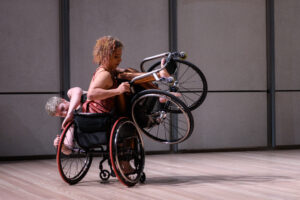
Laurel Lawson lays across Alice Sheppard’s lap as she pushes Alice’s left wheel rim with both hands. They wear shimmery costumes in autumnal tones as they spin in their wheelchairs. Photo by Filip Wolak / Whitney Museum of American Art.
Under Momentum struck me as the most concentrated and focused introduction to the work of the dancer/choreographers and the KL Ensemble that I might imagine. I rued the fact that the Dancing Matters group proved too early in its evolution to organize quickly enough to snag tickets before the show sold out. The piece provided a clinic in contemporary dance creation and performance at the highest level. Standing in the exit aisle at the right side of the audience, having been encouraged like everyone else to stand, sit or move around by the introductory hosts, I found myself able to maneuver consistently in such a way as to intently study every move and transition on the stage while keeping Israilov’s dance-like ASL interpretation of the musical score easily in view.
This simple accommodation freed the experience from a one-way presentation vibe and enabled a more interactive approach sans the stifling and in many cases unnecessary and even counterproductive regimens of most Western theatrical events. Its liberating and humanizing effect allowed a girlchild of perhaps five to seven years old to lie on the floor in a gap among the wheel and power chairs in a taped off area at the very front of the audience surrounded by coloring books that she never made use of in my observation, so fascinating did she find the goings on in front of her that, chin propped on her hands over bent elbows, she could almost have reached out to touch.
Lawson and Sheppard began the piece without their wheelchairs in a slowly unfolding and developing adagio duet atop one or two of the longest ramp elements turned on their side. They followed this section with a suite of other sections mostly involving dancing in and out of wheelchairs punctuated intermittently with blue tinted half-light reconfigurations of the set by a crew of stagehands.
The subtly shifting and affective lighting design by ensemble member Michael Maag came to the fore in these transitions, supporting mostly in silence/ambient sound an air of unfolding mystery that served as counterpoint to the excellent recorded score drawn from multiple composers and supplemented with a haptic experience design by Lawson and realized with the help of David Bobier and Jim Ruxton ofVibraFusion labs.
Over the course of the work’s 80-minute duration with intermission, I felt an increasing excitement as if Lawson and Sheppard had enabled me to re-live and reinterpret my own earliest, though later in life than most dancers, training in modern dance technique and composition. Here I found myself re experiencing side falls and lateral stretches, theme and variations and even balletic set pieces that I have been witnessing ever since I got into performative dancing and dance making.
Sequential solos for Sheppard and then Lawson featured some of the most amazing innovations and reimaginings I’ve seen performed in wheelchairs; extraordinary feats of invention and physical power. At one point in her solo Sheppard executes a series of side rolls on the floor in her wheelchair tracing a circle around the center of the stage: a terrestrial reinvention of the ring of airborne barrel turns so commonly performed in the male principal dancer and soloist variations of ballet.
Laurel Lawson lays across Alice Sheppard’s lap as she pushes Alice’s left wheel rim with both hands. They wear shimmery costumes in autumnal tones as they spin in their wheelchairs. Photo by Filip Wolak / Whitney Museum of American Art.
Every traditional dance iteration transforms itself in the bodies and minds of these two and their collaborators. This complements inventions and passages, such as what I will call the Sisyphean mirror duet, made possible only by utilizing the chairs and ramps.
Compositionally, the works’ structural rhythm, variation and even the pauses for set redeployment along with the sound score all add to more than the sum of the parts. The subtle and supple development of the onstage relationship between Lawson and Sheppard as both individuals and partners created an understated layer of dramatic intrigue. Oh, how I wish the Dancing Matters group could have experienced and discussed all this with me.
Dean Moss’ Your marks and surface
Dancespace Project, St. Marks Church in the Bowery, February 24, 2023
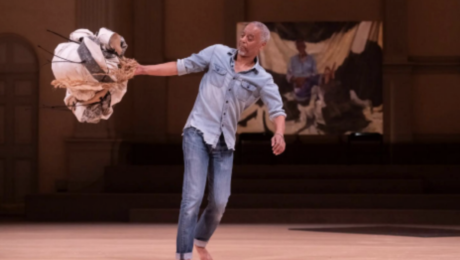
Dean Moss, a black man wearing blue jeans and a lighter blue chambray shirt, leans to his left to counterbalance a bundle of white cotton sailcloth with a dark grey reinforcing hem enbedded with grommets threaded with black tie lines all bound up by thicker beige ropes as he swings the bundle away from himself in his right hand. Behind him loom the sacristy steps of St. Marks Church atop which sits a large portrait of a seated Moss dressed in the same clothes painted by Angela Dufresne . Photo from Moss’ “Your marks and surface,” Danspace Project, 2023. Photo by Ian Douglas.
The doors to the nave at St. Marks opened as usual before a Danspace performance and the knot of audience that had formed in the vestibule began to shuffle in. On the right side toward the midst of the main space beyond them, I glimpsed a trim middle-aged black man barefoot in work clothes – a pair of blue jeans with folded up cuffs at the ankles topped by a blue chambray shirt, long sleeves rolled up to the elbows. He dragged over his left shoulder and behind him a large sack of gathered cotton sail cloth complete with grommets threaded through with both black cotton tie line and fraying loose ended jute, hemp or sisal halyards of the type traditionally used for jib and main sheets on large sailboats. The lumpy cargo enclosed within this sailcloth appeared to be almost as tall as the adult human hauling it and at least twice as wide. The effort and energy required looked to be considerable from the way his body leaned forward and his legs struggled to move its weight across the polished wooden floor.
This became for me only the first of what dance writer Siobhan Burke in her excellent New York Times review recalled as “So many potent images <that> linger in the aftermath of Dean Moss’s” largely solo work Your marks and surface. In the lively nine-person Dancing Matters discussion that followed the show, over cocktails and compote, borscht, pierogis, and other delicacies at the nearby Ukrainian East Village Restaurant inside the Ukrainian National Home, the idea of images that linger and that help frame and reframe the affect of a movement work came into play.
The initial reaction of most members of the group to this affect ranged from dismissive to puzzled with a side of irritation. In the course of an honest hour-long back and forth, however, evidence of a relatively intense level of engagement among members of a dance audience, albeit negative at the outset, seemed to emerge. Palpable pain as well as the indelibility of the images seemed to bracket the debate.
Full disclosure: I worked with Moss for 2 ½ years as part of his six-person onstage ensemble for Nameless forest over a decade ago. In the course of that experience, I read a description of him as a “slippery” cross discipline artist. He can certainly be challenging in a way that I find leans to the good. I remember his fellow multi-discipline artist Ralph Lemon, invited to an in-process iteration of that work, challenging friend and colleague Moss concerning Nameless forest, still without its defining finale sequence. It remained, in Lemon’s view, “not transgressive enough” in the way that he had come to expect from a Moss opus.
Part of the edginess of a Moss work over the last 20 years or so has involved the ingenious and constantly evolving way he has involved the audience within the corpus of the work itself. Burke notes this within her review by quoting theater artist Young Jean Lee’s characterization of her sometime collaborator Moss as “the expert in that field.” When Kinetic Light proved a ticketing bridge too far for Dancing Matters, I warily suggested Your marks and surface as a replacement, carefully noting Danspace’s caveats that the piece “contains mature content” and that voluntary “audience participation <might be> included.” I told anyone who asked that I had no idea what to expect.
In retrospect, although I wish we could have seen KL as a cohort and discussed Under Momentum in the relatively posh and conducive confines of the remade lobby of David Geffen Hall, I have no regrets about the way things worked out and where we ended up digesting. I feel rather pleased instead to have provided an introduction to the work of a prickly old friend to people I have mostly met lately. As an auspicious bonus, on a pre-show visit to the restaurant I had discovered that a milonga would be in progress through two pairs of open double doors in an adjacent space down a few steps from the Ukrainian dining room and, in true DanceFest fashion, social dancing would accompany our late dinner and discussion.
It came to pass that I alone among our group became an audience participant in Your marks and surface. I had already claimed what I considered the prime “escape and audience observation” perch in the end seat of the top row at the southwestern (narrow) end of the risers facing into the nave, having discovered that most of the audience would be arrayed along the long east southeastern wall approximately 45 feet to my right. Already enjoying the relative freedom of movement that this “escape seat” would afford me, I had begun to roam, greeting other performers and friends from Dean’s previous works, second and third cousins from his extended artistic family network.
I had noted that some of these cousins had been receiving a Moss escort around the now abandoned bundle resting almost directly in front of my seat near the southwest corner of the nave. I felt safe, however, from his attention until, while chatting with David Hamilton Thompson, I felt his hand on my shoulder inviting me into sojourn. This tour progressed as completely natural up to a point. We began chatting and laughing as old friends and Dean’s manner and interaction remained friendly and forgiving throughout except when his hand around my shoulder or waist gently but firmly reminded me to keep walking or seemed to tilt me slightly off balance on my feet.
This admonished me that Moss may prefer to keep almost everyone, audience and performers alike, just a little on edge. More than once during the making, run and touring of Nameless forest I had remarked that part of the challenge of preparing that work involved letting a good deal of what I had absorbed through my professional dance training fall away temporarily to keep everything as alive as possible within the relatively strict structural limitations of the set and Dean’s choreographic designs. It seemed that whenever a sequence began to approach something people might begin to recognize as “dance” Dean would twist or break its form to keep everyone alert and creatively uncomfortable.
This ethic extended to envelop not only we six performing among the fresh dozen or so folks at each performance whom we had seduced, cajoled, beguiled or otherwise convinced, to join us onstage and take part in they knew not what and about which we could only make a practiced and educated guess that we could not reliably share with them. These recruitments took place during the audience takes its seats interim corresponding to that of the Your marks and surface’s walkabouts. Like Moss in the latter piece, we would already be found onstage as the ticket holders entered the theater proper.
Upon my release from our walk and return to my seat, I came to believe that this might be the most intimate and effective way of greeting and welcoming old and new friends and colleagues at the top of a show that I had ever seen or experienced. The once-around-the-stage stroll had a way of taking into the creator’s confidence some of us who had become familiar with Moss’ process and proclivities, as well as others who perhaps might not. Unlike the house opening sequence of the Broadway show Once, which allowed the paying customers to climb onto the stage boards and order a pint from the working taps of the pub built as the stage set prior to the cell phone announcement and the dimming of the house lights, the auteur/performer and not the patron determined the protocol here. (I never noticed whether a ramp or other accommodation had been offered in the Once gambit, while here the single level from the vestibule to nave would obviate such a consideration.)
Siobhan Burke has more than adequately described a great deal of the rest of the proceedings and I prefer to leave any outstanding observations and other resonant thoughts to other members of the Dancing Matters cohort in the comments below. I invite and welcome your input with a couple of parting notes:
Our post performance discussion reinforced for me how much the perception and processing of any challenging aesthetic depends on one’s perspective and often preconception. “Do you consider this dance?” has become an oft repeated and not unwelcome question since the heady days of the Judson Dance Theatre and, I might speculate, perhaps for eons before then. For Your marks and surface this implicated quite literally my choice of seating.
Shooed back into my chair by the stern and watchful house manager, I found myself still situated ideally to be able to watch both the action and most of the audience for the duration of the proceedings. But from the unwrapping of the original bundle to reveal a sculptural serpentine pyramid shaped mound within, a mound that would much later itself be unwound to reveal a softly writhing red orange shag bag with a body inside, I did not, from my angle, perceive the bare foot sticking out from the mound in the direction of the bulk of the crowd and plainly visible to most of the rest of my DM companions. This allowed me to fantasize about the contents of the bag that appeared revealed under the chair that served as the armature for the mound-pyramid long enough to wonder, when first seeing it move, whether it might be a collection of Roomba tribble-like balls in spite of my awareness of the credited inclusion of the dancer Sawami Fukuoka as a performer in the piece far in advance of the show. I had even seen some of Moss’ posted video work with her leading up to this piece. Fool me twice, shame on me.
In a related exercise in perception, I took notes across the duration of the event of the kind that I have not taken since giving up my four year stint as a mostly summertime dance critic for a daily newspaper. I deployed this tool in preparation for the post-partum discussion that follows as a feature of every Dancing Matters adventure, still stung by the humiliating experience of trying to recollect from memory for an academic paper the sequence of Moss’ johnbrown (2014), his successor project to Nameless forest, and failing miserably in the attempt. Having learned from my newspaper days that I could barely if at all read any of the scribbles that I made in the dark or half-light while continuing to take in a dance work, I have pared down my notations to those of time by the clock and a word or three as memory aid to recall a precise progression.
This turned out to be superfluous for the most part in recalling the present piece whose striking images and (Ravel’s) Bolero-like sequencing remain so vivid at this writing. Yet the timings reveal such an intricate temporal structure as to rival those of theater director and sometimes choreographer Robert Wilson in their rigor and clarity. Here the potent images and sounds that Burke references in her review, spare as she says, yet pregnant with a raw resonance that Wilson’s striking, stylized, polished and highly technically produced spectacles often lack for me do indeed linger.
My Dancing Matters colleagues confirmed later that they too, as audience, consistently had time to collect impressions, process, and allow associations, images and experiences from their own lives to rise up within them even as the pace of Moss’ looping variations increased in physical force and seeming sense of impatience. I will share a few that persist for me and the context in which I conjured their resonance in a personal way:
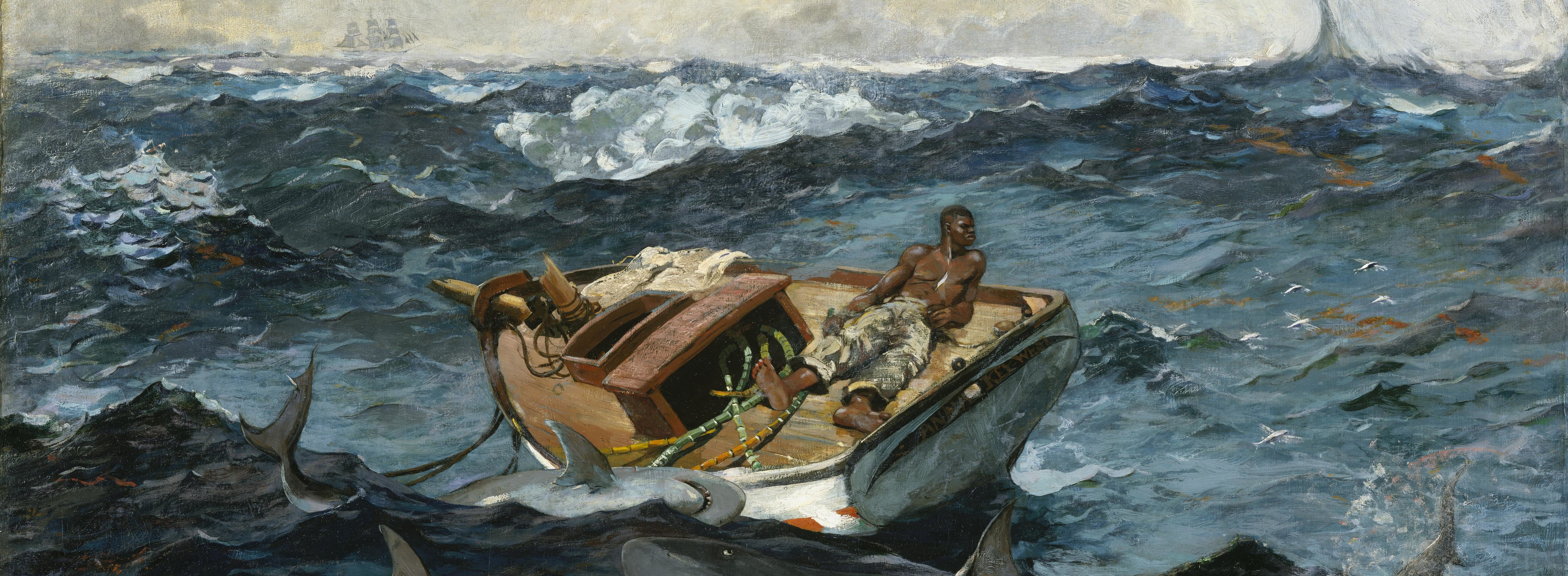
- After unwrapping his bundle and exposing the sculptural pyramid mound, Moss wrestles his sailcloth around the stage to unfurl it across the floor with what had been its interior side facing the ceiling and sits on it with his legs splayed out near one end of its length. In the brief but stage-long stillness that follows, his figure calls to my mind that of the solitary sailor in Winslow Homer’s The Gulf Stream (1899).
- The black stripes in parallel lines that run the length of the sailcloth on which Moss sits reminded me of various versions of the American flag I have seen from Jasper Johns to Black and White to distressed. I have also seen a grayscale half close up photographic portrait of Moss as a child standing alone and saluting an in his face American flag with his right hand over his heart.
- The dragging of the sailcloth bundle, its heavy cotton unfurling, and the repeated regathering of it between his splayed legs as he sits; his repeated twisting of it and retying into a bundle that variously becomes a compacted burden carried on his back, on his head, as a kind of proto straitjacket around his body, finally as a centrifugal counterweight. Working all that cotton, the ropes, the exhausting repetitiousness of the tasks he seems to compel himself to complete in such deliberate fashion.
Art making has its Sisyphean aspect. Having finished a work, one descends the hill to begin another.
In a final sequence Moss asks matter-of-factly if anyone in the audience will help him. His repeated requests and our initial passive and silent response reminded me of an almost daily occurrence and encounter I have on the subway and sometimes on the street. On about the third try, several people in the audience respond and Moss, on this evening, selects a relatively young bearded white man from among those few who volunteer. As this stalwart naif enters the playing area, Moss begins to describe the ordeal that awaits the stranger involving being wrapped up and then dragged “for a looong time.” The young man walks back towards his seat. It turns out that he wants simply to unload his glasses and jacket before this undertaking.
Their interaction takes on a comic edge that seems unforced and evokes a glimmer of touching mutual vulnerability. Moss manages to keep it somewhat dark as he promises to leave his volunteer in that state without light and disappear. The ordeal turns out to be much more mercifully gentle and brief than threatened. Still we sit as witnesses while an older black man in 2023 drags a younger white man around in his sailcloth while a shrouded figure in red orange shag struggles to its feet from under a chair. Moss, having left the young man as he warned, lifts the figure, cradling the phantom in his arms as he disappears through the door toward the parish hall at the northeast corner of the nave and closes the portal behind them. Stephen Vitiello’s magical intermittent recorded score has disappeared one final time.
The denouement as in other Moss works, has a decidedly ambiguous tone and leaves the audience confused as to how to respond. As promised, we have been left in the dark, abandoned with no applause cue and no return of the credited performers. From where I sit, Angela Dufresne’s painted portrait of a seated Moss in costume with hanging black and white striped linen behind and surrounding his image stares back at me from its easel atop the raised sacristy area at the far end of the nave from me and adjacent to the door that Moss carrying Fukuoka have just exited. It looms over the wrapped figure of our intrepid but hapless volunteer seated in his cocoon on the polished wooden floor. As Carol Mullins’ stage lighting fades and stays down an awkward silence engulfs the darkened room broken by tentative and dispirited applause. I turn to a DM colleague in the adjacent seat in the dark and whisper, “But he told us all what he was gonna do.”
- Published in 2023, Dancing Matters
纽约舞蹈嘉年华COVID-19健康与安全政策


Warning: COVID-19 is an extremely contagious disease that can lead to severe illness and death. There is an inherent and elevated risk of exposure to COVID-19 in any public place or place where people are present and there is no guarantee, expressed or implied, that those attending a Dance Parade event will not be exposed to COVID-19. As per current Federal Center for Disease and Control recommendations, we recommend (but do not require) all participants over the age of five to be fully vaccinated in order to attend our events.
We will continue to monitor the health impact of the COVID-19 pandemic and working with city, state and federal agencies to adjust this policy as needed.
亲爱的舞者,
|
On behalf of the Dance Parade Board, Steering Committee and the broader dance community we serve, I convey our deepest condolences to the families of George Floyd, Ahmaud Arbery, Breonna Taylor, Tony McDadde, Christian Cooper, David McAtee and countless other victims of injustice everywhere.
Dance Parade plays a critical role condemning racial injustice and hate. By presenting as many cultural dances as possible, our work seeks to advance cultural equity, celebrate diversity and inclusion for all people — not just those who are privileged by structural inequities or the color of their skin.
As we recognize #BlackOutTuesday today please take a moment to educate yourself on these issues and consider supporting one or more of the non-profit organizations below who are fighting to change the structural racism that surrounds us.
In solidarity,
Greg Miller
执行董事
NAACP Legal Defense and Education Fund is the country’s top legal firm fighting for racial justice. Through litigation, advocacy, and public education, it seeks structural changes to expand democracy, eliminate disparities, and achieve justice for all. It also defends the gains and protections won over the past 75 years of civil rights struggle.
Poor People’s Campaign confronts the interlocking evils of systemic racism, poverty, and militarism. As a nation we are at a critical juncture — and we need a movement led by working people that will shift the moral narrative, impact policies and elections at every level of government, and build lasting power for poor and impacted people.
Color of Change is the nation’s largest online racial justice organization that helps people respond effectively to injustice in the world around us. As a national online force driven by 1.7 million members, they move decision-makers in corporations and government to create a more human and less hostile world for Black people in America.
The Citizenship Education Fund, founded by the Rev. Jesse Jackson, is working to protect, defend and gain civil rights by leveling the economic and educational playing fields while promoting peace and justice around the world. It is a multi-racial, multi-issue, progressive organization that is dedicated to improving the lives of all people by serving as a voice for the voiceless.
Mijente is a national hub for Latinx and Chincanx organizing that advocates on behalf of those communities as well as other oppressed communities. It has been leading the charge within Spanish language media, attempting to bring awareness and solidarity with Black-led protests and organizations. It serves as a link between many Black-led organizations and Spanish-speaking communities, participating and leading in solidarity actions in several states.
The Bail Project is a national nonprofit organization that pays bail for people in need, reuniting families and restoring the presumption of innocence. In fighting mass incarceration, they aim to secure freedom for as many people as possible and ensure equal justice for all.
These groups are doing important work in communities all across the country, and now more than ever they are counting on our support.
|
     #TheShowMustBePaused #BlackOutTuesday #BlackLivesMatter
#DanceWithoutBorders #DanceParadeNYC
Dance Parade is a 501(c)3 Non-Profit Organization
|
- Published in 2020
像“傻瓜”一样跳舞的重要性
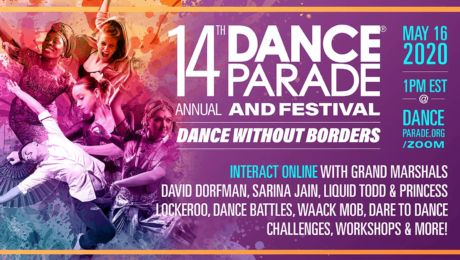
5月16日星期六,【第14届纽约舞蹈嘉年华 · 巡游及狂欢】将在线上如期举行!舞蹈嘉年华欢迎所有人从世界任何角落加入参与。
Join thousands of professional dancers and plain ‘ol dance moms, kids, teens and older adults as we boogie down to DJs. Register for the FREE virtual parade here.
“像‘傻瓜’一样跳舞的重要性”听起来可能有些奇怪,但是这个视频里所讲述的概念不妨一看!
支持我们就可以获取独家金主福利!
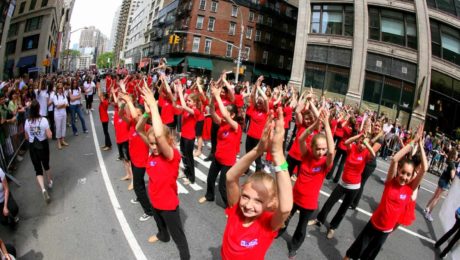
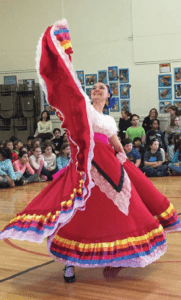
The pandemic has affected us all and has made us appreciate the things we hold dear. That’s why we are dedicating this year’s #GivingTuesday on November 30, 2021 to our Teaching Artists that bring the gift of dance to schools and community centers. Won’t you join us in this global dav of giving?
Our 2021 theme Back To The Streets was chosen by the NYC Dance Community and celebrates our love of dance and our values of diversity, cultural equity and inclusion. We are scheduled to dance live on Broadway Saturday May 22nd, 2021 in the city’s largest dance event to showcase over 100 unique styles of dance.
In these past two years we overcame the challenges of dancing with the pandemic and delivered over 2500 youth and 300 adults with free classes online. Our programs funded teaching artists who danced with kids and older folks alike to support healthier, happier lives.
100% of your contribution will go to the artists and means so much to us and we are grateful for every tax-deductible donation, no matter how small!
HERE ARE THE PERKS WE OFFER FOR YOUR SUPPORT:
Friend of Dance: $20
- Participate in Dance Parade knowing you helped make the world’s large display of diverse cultures possible!
Dance Spirit: $50
- Your donation will be used where it is needed most.
- Recognition on our website as a Dance Spirit
- Get mailed a personal thank you letter from our director that includes a receipt letter for a 100% tax deductible donation
Mover & Shaker: $100
- All of the above and . . .
- Recognition on our website as a Mover & Shaker
- Get a commemorative “We Dance Together Again” refrigerator magnet
- Sponsor a Dance Organization of your choice in the 15th Annual Dance Parade May 22, 2021
Gifted Dancer: $150
- All of the above and . . .
- Recognition on our website as a Gifted Dancer
- Get a commemorative “We Dance Together Again Tote bag
- Get a signed photograph with the group you sponsor
Dance Angel: Donation level, $250 or more
- All of the above and . . .
- Recognition on our website as a Dance Angel
- Complimentary admission to the Dance Parade After Party
- Sponsor a Diversity Workshop in a New York City public school
- Get acknowledged by a personal Tweet and post to our Facebook Page
- View the parade as our guest in the Grandstand
How to donate:
Make check payable to “Dance Parade” and mail to:
455 FDR Drive, Suite B104, New York, NY 10002
Alternatively, use a credit card to contribute through our secure website here:

Thank you so much for your support!
Photo Credit: Joon Shin

Responding to the Census
Your Invitation To Respond
The time is now. Help shape your future, and your community’s future, by responding to the 2020 Census.
Most households received their invitation to respond to the 2020 Census between March 12 – 20. These official Census Bureau mailings will include detailed information and a Census ID for completing the Census online.
In addition to an invitation to respond, some households will receive a paper questionnaire (sometimes known as the census form). You do not need to wait for your paper questionnaire to respond to the Census.
The 2020 Census is for everyone.
Please complete your form online, by phone, or by mail when your invitation to respond arrives. Visit my2020census.gov to begin.
How To Respond
The 2020 Census will ask a few simple questions about you and everyone who is or will be living with you on April 1, 2020.
For the first time, you can choose to complete the census online, by phone, or by mail. Find out more about each of these methods below:
Please note that if you are responding online, you must complete the census in one sitting, as you don’t have the ability to save your progress. See the questions the census asks here.
If you do not receive an invitation to respond from the Census Bureau, you may respond online or visit our 联系我们 page to call our phone line.
Who Should Respond
The 2020 Census counts everyone living in the United States and its five territories (Puerto Rico, American Samoa, the Commonwealth of the Northern Mariana Islands, Guam, and the U.S. Virgin Islands).
One person should respond for each home. That person must be at least 15 years old. They should live in the home or place of residence themselves and know general information about each person living there. (For more information, visit Questions Asked.)
Please note: If you live in American Samoa, the Commonwealth of the Northern Mariana Islands, Guam, or the U.S. Virgin Islands, the process for completing the census will be 100% paper-based and led by Census takers. Visit Counting the Island Areas for more information.
Everyone Counts
The Census Bureau has specific operations and processes in place to count everyone, including those in group living situations such as college dorms, nursing homes, military barracks, and prisons.
Who Should Be Counted and Where?
You should be counted where you are living and sleeping most of the time as of April 1, 2020. If you are responding for your home, count everyone who lives and sleeps there most of the time as of April 1, 2020. This includes young children, foster children, roommates, and any family members or friends who are living with you, even temporarily.
Please note that if someone is staying with you temporarily on April 1 due to the COVID-19 situation, they should be counted where they usually live. This includes college students, who should still be counted at school, even if they are home early because of the COVID-19 situation. If they live in student housing, the college will count them. If they live off campus, they should respond for the off-campus address and include any roommates or other people living there.
If someone is staying with you on April 1 who doesn’t have a usual home elsewhere, please include them in your response.
People in some living situations—including students, service members, and people in health care facilities—may have questions about how to respond or where they should count themselves. You may also have questions if you are moving, have multiple residences, or have no permanent address.
For more information, please visit Who to Count.
Language Support
You can complete the census online or by phone in 13 different languages: English, Spanish, Chinese, Vietnamese, Korean, Russian, Arabic, Tagalog, Polish, French, Haitian Creole, Portuguese, and Japanese.
In addition, bilingual invitations and paper questionnaires in English and Spanish will be sent to select areas of the country.
To help you respond, the Census Bureau also offers webpages and guides in 59 non-English languages, including American Sign Language, as well as guides in Braille and large print. Visit Language Support to learn more.
- Published in 2020
团队亮点:向大家隆重介绍Dori,带领团队的拉丁舞者!
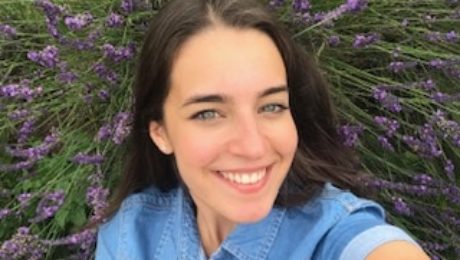
In each issue of our STEPS! E-Newsletter we try to cast the Spotlight on one of our awesome team members to find out more about where they came from and to suss out their connection to dance and supporting the Dance Parade team. In this issue, we put the spotlight on Dori Garcia.
Hi Dori, Thanks for taking time out of your busy schedule to talk with us!
How did you first find out about Dance Parade?
I found out through my partner who was taking a Cuban Salsa Class with the organization’s director, Greg Miller.
What is your current role in Dance Parade New York?
I am the Team Coordinator and Project Manager. I basically work with all the committee chairs to place prospective team members. We are seeking over 200 this year so I’m looking forward to the challenge!
What is your favorite style of dance to watch? to participate in?
I love the latin dances. Tango is one of the most expressive dances I know and when I see it, I just get wowed!
What is your background or interest in dance?
I was raised in Alicante, Spain and have been practicing salsa on and off since I was five year’s old. I would go with my Aunti in Spain and do my own steps on the side. I also learned contemporary after school and now take bachata classes here in NYC.
If you could share the stage with anyone in history, famous or not, living or deceased, a trained dancer or not, performing a routine choreographed by yourself…who would it be?
I just absolutely love Ataca Y la Alemana, bachatta dancers.
Last year we celebrated the theme “Movement of the People” What does this year’s theme “Dance Without Borders ” mean to you?
I think Dance Without Borders demonstrates that it doesn’t matter where you come from or what your abilities/capabilities are—There are no limitations in order to dance and you can still share your passion to dance.
What dance group or dance style are you most looking forward to seeing this coming year in the parade?
I can’t wait to see the Cuban Rueda salsa. At the Dance Parade event “Winter’s Eve” at Columbus Circle, I saw Fuakata Cuban Ensemble choreographed and led by Chris Rojecki and they were just amazing.
If you could choose Grand Marshal for next year’s parade….who would it be?
I would love to see Shakira because she’s so passionate and helps others through her charity work.
If you could pick another country to hold a Dance Parade and Festival….which would it be?
Definetely Spain!
Working for a nonprofit organization can at times be daunting and frustrating with limited personnel and funding….what is it that keeps you coming back for more and more?
I had heard about Dance Parade before I came to New York and since I’m passionate about dance, it’s just amazing to me that I’m a part of an organization that allows us to express ourselves–and we do it in my favorite form–Dancing!
What pitch would you use to attract a new volunteer onto the Dance Parade team?
It’s a great opportunity to do something that makes a difference for so many people. And it’s a lot of fun and we put it all together in such a positive way—A lot of work but so worth it!
- Published in 未分类
团队亮点:向大家隆重介绍Ali Coleman!
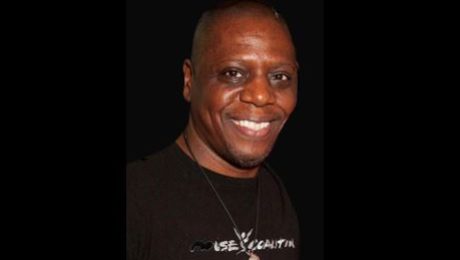
In each issue of our STEPS! Newsletter we try to cast the Spotlight on one of our awesome team members to find out more about where they came from and to suss out their connection to dance and supporting the Dance Parade team. In this issue, we put the spotlight on Ali Coleman.
Hi, Ali. Thanks for taking time out of your busy schedule to talk with us.
What is your current role with Dance Parade?

My current role with Dance Parade is helping to coordinate Sponsorship. For me, I’ve been involved coordinating the House Coalition along with Luis Vargas for 14 years and consider Dance Parade as the Super Bowl of all my events each year! Having run an ad agency with a lot of nightlife industry contacts, I’m pyshced to join Dance Parade’s Steering Committee, many of whom I’ve known for years.
What are you up to when you’re not helping with Dance Parade?
I am a veteran NYC DJ, party organizer & promoter and Nightlife Advocate.
What is your favorite style of dance to watch? to participate in?
I Love to watch all styles of dance, but I would say that Pasodoble is my favorite to watch…such power in the movement! My favorite to participate in is ‘Freestyle’…no structure, just free movement.
Check out this video if you would like to know more about Pasodoble!
(sadly we didn’t catch Ali Coleman dancing to it..just yet!)
What is your dance background or interest in dance?
I’ve always been an avid dancer. I had my 1st dance performance on stage at the age of 5 in my elementary school’s talent show. For me dance is akin to breathing…without dance there is no life!
If you could share the stage with anyone in history famous or not, living or deceased, a trained dancer or not, performing a routine choreographed by yourself…who would it be?
The Nicholas Brothers, definitely!

Last year we honored immigrants and indiginous dance with “Movement of the People”. The year before, we celebrate the repeal of the Cabaret Law with the theme “The Cabaret of Life” — What does the 2020’s theme “Dance Without Borders ” mean to you?
Dance Without Boarders confirms what I’ve said for many years now.. I believe that anywhere we go on earth there is music and there are people dancing to that music.
What dance group or dance style are you most looking forward to seeing this coming year in the parade?
That’s a hard one….Dance Parade is like eating Sashimi…so many spectacular dance styles…impossible to pick just one

If you could choose a Grand Marshal for this year’s parade….who would it be?
Francois K.
If you could pick another country to hold a Dance Parade and Festival….which would it be?
Germany, Amsterdam…Japan would be phenomenal!!
Working for a non profit organization can at times be daunting and frustrating with limited personnel and funding….what is it that keeps you coming back for more and more?
Dance Parade encompasses everything that I believe at my core. It involves all cultures sharing in one of our most ancient communal activities! It’s one of my favorite days of the year!!
Describe a special memory you have from Dance Parades past?
One of my special memories is of the very 1st parade…I remember being very excited for that day to arrive, and didn’t even dance in the 1st parade. Instead I stood on the corner of 5th Ave between 8th street & Washington Square (north) to capture the parade on video!! Just thinking about it now has a big smile on my face!
What pitch would you use to attract a new volunteer onto the Dance Parade team?
Dance Parade is absolutely the most fun you’ll ever have working!!!
